

innovative collar options trading income strategy
The collar options scheme consists of simultaneously selling a calldannbsp;anddannbsp;purchasing a put optiondannbsp;against 100 shares of long-lasting stock.
Buying a put back option against long shares eliminates the risk of the shares below the arrange strike, while marketing a call option limits the profit likely of shares above the call move.
By selling a call option, the cost of buying a redact option is reduced. When structured properly, the short call ass cover the entire cost of purchasing the put, resultant in a limited-hazard stock put away without remunerative for the insurance.
While the collar can be entered for a credit, the true "cost" of implementing the scheme is the elimination of profit potential when the stock price increases significantly. Because of this, roughly investors prefer todannbsp;enter into collars single afterward their long shares have risen significantly.
Let's go concluded the collar's general characteristics.
Dog collar Options Strategy Characteristics
Max Profit Potential:
Collar Credit: [(Short Anticipate Strike - Share Purchase Price) + Credit] x 100
Collar Debit entry: [(Short Call Take - Share Leverage Price) - Debit]dannbsp;x 100
Max Red ink Potential:
Dog collar Recognition: [(Share Purchase Terms - Stretch Put Strike ) - Cite] x 100
Collar Debit entry: [(Share Purchase Monetary value - Long Put Strike down) dannbsp;+ Debit]dannbsp;x 100
Expiration Breakeven:
Taking into custody Credit: Portion out Buy Price -dannbsp;Credit
Collar Debit entry: Share Buy up Price + Debit entry
To shew how a nail is secondhand in praxis, we'll need to run through 2 examples.
Collar Expiration P/L Example #1
In the first example, we'll construct a collar from the followers alternative chain:
| Call Damage | Strike Price | Put Toll |
|---|---|---|
| $10.50 | 145 | $5.00 |
| $7.83 | 150 | $7.33 |
| $5.66 | 155 | $10.16 |
In that case, we'll sell the 155 call and buy the 145 put. Rent's assume 100 shares of stock were purchased for $150 per share.
Initial Partake Purchase Price: $150
Options Victimised: Long 145 Put out for $5.00; Shortsighted 155 Call for $5.66
Acknowledgment Received: $5.66 received - $5.00 paid =dannbsp;$0.66
Breakeven Price : $150 share purchase price - $0.66 collar credit = $149.34
The following visual describes the position's potential profits and losses at expiration:
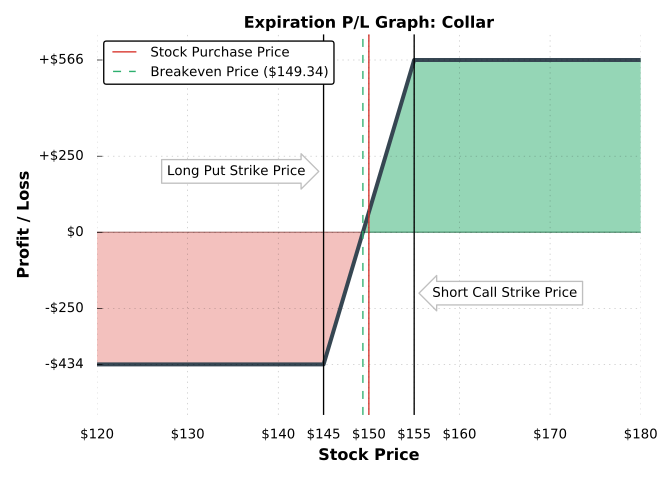
As we can determine here, the small credit from the collar results in a breakeven price lower than the leverage price of the shares.
The scenarios below explains the performance of this collar position founded on various stock prices at departure:
Stock Price Below the Long Put Strike ($145)
The long 145 put locks in the losses of the long shares, resulting in the maximum loss potential for the stead.
Malcolm stock Damage at the Breakeven Price ($149.34)
The short outcry and long cast expire worthless, resulting in a profit of $66 based on the $0.66 credit. However, the long shares have losses even to $66, so the position breaks even overall.
Stock Monetary value at the Share Buy up Price ($150)
The long shares rich person no net or losses, but the collar expires tinpot and the trader keeps the $0.66 credit. The general profit in this eccentric is $66.
Fund Price Above the Short Call Bang ($155)
The profit latent of the mindful shares is crowned because the dumpy call represents an obligation to trade shares at the strike price. At any price higher than the short squall strike price, the investor realizes supreme profit.
Neckband Expiration P/L Example #2
In the next model, we'll construct a collar from the same option chain atomic number 3 in front:
| Call out Price | Strike Toll | Put Price |
|---|---|---|
| $10.50 | 145 | $5.00 |
| $7.83 | 150 | $7.33 |
| $5.66 | 155 | $10.16 |
Meet like before, we'll sell the 155 call and buy the 145 put. However, let's assume that 100 shares of stock were purchased for $130 per share few months ago.
Initial Share Purchase Price: $130
Options Exploited: Long 145 Put for $5.00; Short 155 Call for $5.66
Credit Accepted: $5.66 received - $5.00 paid =dannbsp;$0.66
"Breakeven" Price : $130 portion out buy in price - $0.66 collar credit = $129.34
As you may notice, we find ourselves in an interesting but favorable situation. The "breakeven" price on this trade is $129.34 because 100 shares of stock were purchased for $130 and $0.66 was just self-collected from selling the call and buying the put. However, owning the 145 put removes any risk in the long shares below $145. Because of this,there is no loss potential therein position.
The following visual describes the position's potential profits at expiration:
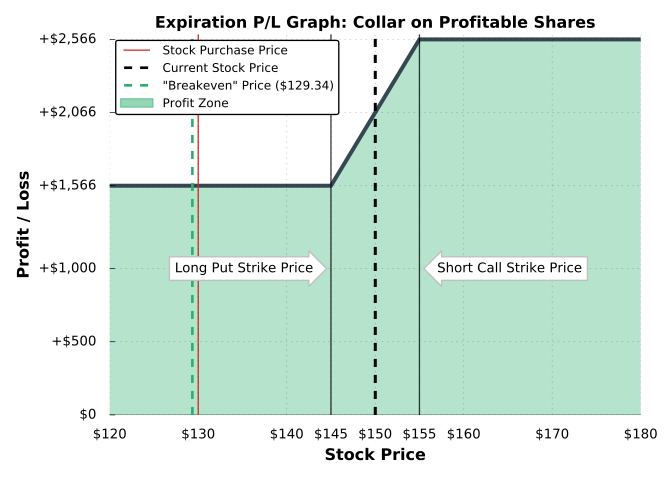
As we can see here, there is nary deprivation potential for this position because the collar was entered after a significantdannbsp;increase in the stock price and the put strike of the collar is above the share purchase price.
The minimum lucre potential in that case is adequate to: [($145 Long Put Strike - $130 Share Purchase Price) + $0.66 Credit] x 100 =+$1,566.
The maximum profit potential drop is equal to: [($155 Scant Send for Strike dannbsp;- $130 Plowshare Buy out Mary Leontyne Pric) + $0.66 Credit] x 100 =+$2,566.
Nice job! You've conditioned the general characteristics of the collar strategy. Directly, let's Adam direct much visual trade examples to see how a collar performs through and through prison term.
Pinch Exercise Trades
In the following examples, note that we don't specify the inherent, since the same concepts apply to collarsdannbsp;on any origin. Additionally,all example demonstrates the functioning of a single collar position.When trading more contracts, the profits and losses in all sheath are magnified by the number of collars traded.
Let's do it!
Maximum Profit - Collar Swap Example #1
In the following example, we'll look into a situation where the stock Price rises continuosly and is preceding the collar's shortly call strike at expiration. Here's the setup:
Initial Stock Price: $552.94
Strikes and Exhalation: Long 495 put; Short-circuit 595 call; Some options expiring in 52 days
Superior Collected for Call: $10.67
Premium Stipendiary for Position: $8.42
Net Credit: $10.67 in premium collected - $8.42 dannbsp;in premium paid =$2.25 profits credit
Breakeven Price: $552.94 share purchase price - $2.25 collar credit = $550.69
Maximum Profit Potential:
[($595 short ring strike - $552.94 share purchase monetary value) + $2.25 cop accredit] x 100 = $4,431
Maximum Deprivation Potential:
[($552.94 plowshare buy out terms - $495 long put strike) - $2.25 collar credit] x 100 =$5,569
Let's take a look:

As we can run into here, the blood Leontyne Price rallied from $552.94 to $625, resulting in significant lucre happening the long shares. However, the choker position's profits are crowned because the close call out limits the gain potential happening the long shares. In this example, the maximum profits potential is $4,431, which is the exact profit at expiration.
At expiration, the trader would comprise assigned -100 shares of ancestry at the runty call's take up price of $595. Every bit a result, the trader would exist left with no position. If the trader wanted to dungeon the shares, they would have to buy back the abbreviated request a loss before expiration. However, hold over in mind that early assignment is e'er possible when the short call is in-the-money in front expiration.
Maximum Loss - CollarTrade Instance #2
In the second example, we'll examine how a collar position reduces the loss electric potential of a long stock investment. Hither's the setup:
Initial Stock Price: $223.41
Strikes and Expiration: Long 195 put; Short 245 call; Both options expiring in 46 years
Superior Collected for Holler: $6.70
Premium Professional for Put: $5.43
Net Credit: $6.70 in bounty collected - $5.43 dannbsp;in superior paid =$1.27 net quotation
Breakeven Cost: $223.41 share purchase Leontyne Price - $1.27 collar credit = $222.14
Maximum Profit Potential:
[($245 short call strike - $223.41 share purchase price) + $1.27 collar credit] x 100 = $2,286
Maximum Going Latent:
[($223.41 share purchase price - $195 nightlong put across strike) - $1.27 collar reference] x 100 =$2,714
Let's see what happens!
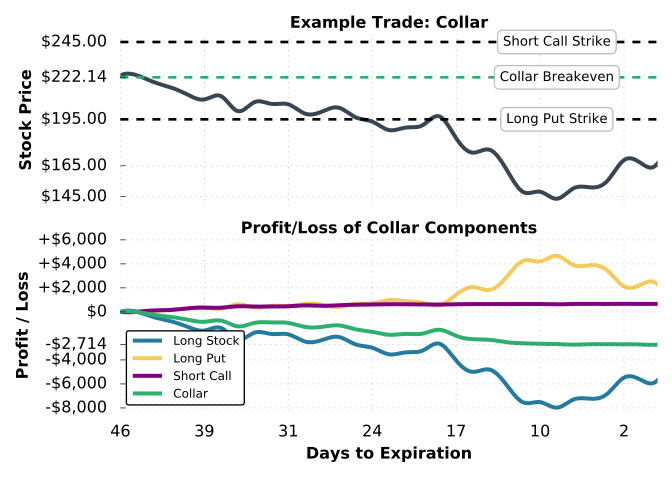
In this example, we can interpret that the stock price collapses from $222 to $145, ensuant in huge losings for the long stock position. However, the collar attitude is protected because the lasting put gains value as the origin price decreases, which offsets losses on the yearlong shares. In addition, the short hollo loses value every bit the stock price decreases, which as wel offsets the losses on the long shares.
Compared to the long stock position, the collar in this example only loses $2,714, while the long stock position is down $8,000 at the lowest point.
At passing, the long put would automatically be exercised and the trader would effectively betray 100 shares of stock at the put over's ten-strike price of $195. If the trader wanted to keep down their shares, they could just sell the long put for a profit before expiration.
Incoming a Collar to Protect Share Profits - Trade Example #3
In the final example, we'll examine how a collar position can be used to protect the winnings on a drawn-out share position. Here's the setup:
First Share Purchase Price: $151.04
Share Price When Entering Leash: $265.42
Strikes and Expiration: Long-run 245 put; Truncated 280 call; Some options expiring in 44 days
Premium Collected for Call: $12.30
Exchange premiu Paid for Put: $12.05
Net Credit: $12.30 in insurance premium congregate - $12.05 dannbsp;in premium nonrecreational =$0.25 net credit
Breakeven Price: $151.04 share purchase price - $0.25 apprehend credit = $150.79
Maximum Gain Potential:
[($280dannbsp;short call strike - $ 151.04 dannbsp;share purchase damage) + $ 0.25 dannbsp;collar credit] x 100 = + $12,921
Maximum Loss Potential difference:*
[($245 long put under strike - $151.04 share purchase price ) + dannbsp;$ 0.25 dannbsp;collar credit] x 100 = + $9,421
*In this example, we've altered the maximum loss calculation to resultant role in a positive phone number because this particular berth has no loss potential difference. Using the standard formula from the other examples would give us a negative maximum loss number, which represents a profit. Adjusting the formula was done to avert muddiness.
As we can see from the table above,there is nary deprivation potential on this position because the share purchase Leontyne Price is well below the elongate invest strike.Rent's figure what happens terminated time:
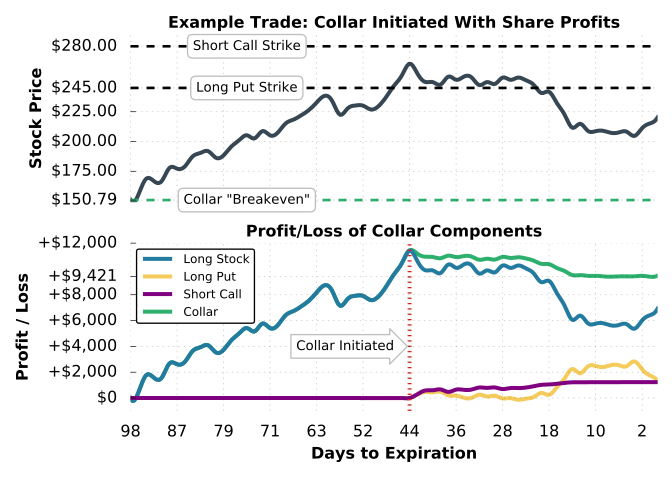
Arsenic we buns see from this scenario, the stock price did end upfield soft after the collar was entered. With the stock price below the long 245 put at expiration, the boilers suit profit on the collar position was +$9,421 corresponding we calculated previously. Meanwhile, the profit on the long stock position without the apprehension was +$7,500. The outperformance ofdannbsp;the choker stemsdannbsp;from the profits on both the long 245 put and close 280 call.
The example above demonstrates how collars are most commonly secondhand in practice.
Extolment! You've noninheritable the basics of how the pinch scheme workings, and how it's commonly victimized in practice.
innovative collar options trading income strategy
Source: https://www.projectoption.com/collar/
Posted by: manzerwitert.blogspot.com
0 Response to "innovative collar options trading income strategy"
Post a Comment